
Tomorrow
Jane Porter chooses Africa. An impossible accident delivers her to Baltimore six centuries later, where Tarzan is remembered and her own future is still hers to invent.
Books by
Samara Bellingham writes romantic adventure, speculative fiction, and reimagined pulp stories about women whose appetites, intelligence, and choices shape the worlds around them.
Follow Samara Bellingham on Instagram ↗
Weekly original fiction
Free until January 1, 2027
A weekly romantic comedy by Samara Bellingham featuring Betty Boop and Pop-Eye. Set between Twenty-Five Dollars a Night and Catalina, it can also be read on its own. All installments are free to read until January 1, 2027.
Read the serial installments free until January 1, 2027. No paid subscription required during this period.
Read a complete chapter
From The Jane Chronicles: The Complete Revised Edition
Part One: Tomorrow · By Samara Bellingham
August Vey’s laboratory was underground, which Jane regarded as a poor beginning.
Dr. Lin Arendt met her at the final door — thirty-five, narrow-faced, unimpressed. “You’ve been medically cleared?”
“For ordinary activity.”
“That isn’t quite what I asked,” Arendt said.
“Then you’ll have to tell me what you intend to do, Doctor, because no one else has.”
“Good,” Vey said, behind her. “She asks before agreeing.”
The laboratory held no single dramatic machine, only worktables and a circular platform behind transparent barriers.
“A reconstruction chamber,” Arendt said. “Of your arrival.”
Dark marks reproduced the Baltimore event field; a twisted strip of dark metal near the center had come, Arendt admitted, from the actual containment facility. Seventeen people had died near that piece of metal. Jane stepped back. Vey said nothing, which she noted in his favor.
“What do you want me to do?” Jane asked, when she trusted her voice again.
“Correct us. About everything.”
Arendt brought up Africa next — an approximation, six centuries removed from the morning it represented. Jane’s father’s tent was on the wrong side; the river sat two feet too high, and the bank lacked the pale mark where the water had stood earlier in the season. Where satellite reconstruction gave the seasonal mean, Jane gave the actual morning.
“How far from the fire?”
“I don’t remember. I was watching my father, not the fire.”
“Estimate.”
“I won’t. If you need memory, I will give you memory. If you need invention, employ a novelist.”
Vey laughed. Arendt, after a pause, said, “Fair.”
“It appears contagious,” Jane told Vey.
Nearly two hours passed. Jane had expected interrogation; instead, Arendt treated her as an unreliable instrument whose readings needed testing, which she found she preferred. Pressure before heat, she confirmed, eyes closed, the clearing returning with terrible ease. The air had thickened before the light gathered.
Then Arendt brought up the buried object, and Jane stopped her outright: too large. Belloc’s estimate had been twelve inches; Jane hadn’t measured it, but she remembered M’Bala’s hand held near it to test the heat, not touching, his palm nearly covering the short side. Arendt adjusted the dimensions against that single detail — and her hands went still on the controls.
“What is it?” Jane asked.
Arendt looked at Vey instead of answering.
“The previous dimensions required a field source larger than the recovered energy profile supports,” she said finally. “At this scale, the source could have been self-contained.”
“In ordinary English, Doctor.”
“The object may have produced the African event.”
Not survived it. Not appeared beside it. Produced it.
“Who made it? Someone from my time?”
“The materials you describe would be extraordinarily difficult to produce with early-twentieth-century methods.”
“Then someone from yours.”
“We don’t know that either.”
For the first time since she’d met him, August Vey forgot to be charming. Jane discovered that she had preferred the charm.
“Could the object still exist?” Vey asked. “In Africa. In your time.”
Something in his face changed — the concentrated attention of a man turning possibility into access. A machine that could open time might still exist six centuries behind them.
Vey wanted it. So did Jane. For one uncomfortable instant, that put them on the same side.
“If we find a way back, the object is not yours. Neither is Africa.”
“You have my agreement,” Vey said, too quickly.
“How disarming.”
“I agreed quickly because you’re right. It’s a rarer reason with me than you’d think.”
Any way back, Arendt explained, would need an anchor — stable physical information shared across events. Location. Material signature. Biological matter. Possibly genetic continuity.
Jane’s hand moved to her abdomen before she could stop it, and this time she left it there. “My child is not equipment.”
“It isn’t,” Arendt agreed, without defensiveness. “Pregnancy may be irrelevant. Your body crossed while carrying another genetically distinct organism. We don’t know whether the field treated that as one system or two.”
“What would you need to determine that?” she asked, and heard how much she wanted the answer.
“Your existing medical data would help.”
“You may not have it. My body has been examined by quite enough strangers this month.”
Arendt nodded at once — no persuasion, no appeal to the greater good. “Then no. We proceed without it.”
A man crossed the lab to murmur in Vey’s ear. One word carried: Continuity.
“Commissioner Vale knows you’re here,” Vey said. “He requested your immediate return.”
“Then I formally decline to return,” Jane said. “Tell him so in exactly those words.”
“He can shut this facility down. Temporarily,” he added, when she pressed. “Under emergency authority, possibly, he could compel you to leave. There is no emergency at present.”
“Then he may come and ask me himself.”
He did, eleven minutes later, without a coat, Jonas trailing him, his temper showing only in how still his face had gone.
“August. You’ve been busy.”
“Rian. Still charming, I see.”
“Not for much longer,” Rian said, and Jonas found somewhere else to look.
His attention moved to Jane and the anger acquired a more immediate object. “Are you all right? Any procedure? Blood? Imaging?”
“No procedure, no blood, no imaging. I have been correcting maps.”
He turned it on Arendt — private field-research authority did not extend to human temporal experimentation — and Jane watched the argument gather its own momentum, carrying her along as its subject rather than its participant.
“Stop. I am standing here.”
“Ask Vey why this facility isn’t authorized to activate temporal equipment,” Rian told her. “It’s because the last field event killed seventeen people.”
The words landed harder than she expected. Regret crossed his face, but he didn’t soften them.
“We are reconstructing data,” Arendt said. “No field generation.”
“What did you learn?” Rian asked Arendt, which surprised Jane more than his arrival had.
“Now you’re interested,” Vey said, delighted.
“I was interested before you stole containment data.”
“Obtained,” Vey corrected, unbothered.
“Restricted contractor records.”
“Improperly restricted.”
“That was not your decision.”
“Apparently it was.”
Two men, each certain his own authority was the necessary one, arguing over her life while she stood between them.
“Enough.” Neither heard her. “Enough.” Both stopped.
She turned on Vey first: he’d invited her here with information Rian withheld and hadn’t mentioned that some of it was obtained against restriction. Then on Rian: he’d classified the African anomaly to keep her recollection uncontaminated — to make her a better witness, not a better-informed person.
“Splendid,” she said. “Both of you possess enormous power, and neither of you thought to tell me anything.”
Silence. Arendt found her display very interesting.
Jane turned back to the reconstruction. “Doctor Arendt thinks the object Belloc found may have generated the African anomaly.”
Rian’s attention snapped to Arendt — confidence, evidence, replicability, the right questions in the right order. He didn’t dismiss the finding because Vey had paid for it, didn’t claim authority he didn’t have. When Arendt corrected him, he changed the question instead of defending the mistake.
She found that inconveniently important.
“Your estimate may matter,” he told Jane. “We need to record it formally, before the model alters your memory further.”
“I’ll do the interview. Here. Because I am tired of being transferred between powerful men as though truth changes ownership depending on the building.”
“Joint record, then,” Rian said, after a silence. “Continuity and Vey’s team each get the complete interview. You get an identical copy. Any annotations stay separate.”
“Who owns the underlying testimony?”
“You do,” Rian said at once. Vey took longer, then agreed.
“Then let us begin, before either of you thinks of another condition.”
The interview lasted three hours. Arendt made her repeat distances and sequence until the clearing felt less like memory than a crime scene revisited too often, and the two men, despite themselves, made an infuriatingly effective pair — Rian catching dangerous assumptions, Vey translating jargon before Jane had to ask. Neither yielded authority gracefully. Between them she got something she’d wanted since Baltimore: information that didn’t cost her ownership of herself to receive.
Afterward, Vey left to take a call. Rian stood by the wall.
“We need to talk. Privately.”
In the small adjoining room, he told her plainly that Vey was using her — not with demands, but by becoming indispensable, solving problems before she asked, until gratitude and agreement became impossible to separate.
“Then what does he collect?” Jane asked. “Not money. Not power he doesn’t already have.”
“People who believe they chose him.”
Jane looked away. The room was small; she was newly conscious of the distance between them, of his sleeves down today, which did not help.
“Why didn’t you tell me this before?”
“I tried. I said, ‘Keep it that way.’”
“That is what a father says before forbidding his daughter an unsuitable man.”
“I am not your father.”
“Thank God,” she said, before she could stop herself.
His gaze dropped to her mouth. Again. Warmth moved low beneath her ribs — no alarm to interrupt it this time, no Tess, no child needing a bird rescued. Only a closed room, and the thing they’d both already noticed.
He didn’t move closer. That made it worse.
“I don’t think you’re incapable of handling Vey,” he said. “I think he’s very good at finding the thing a person wants badly enough to stop measuring the price.”
“My father is dead here. Tarzan is dead here.” Something moved through his face at the name; she let it. “I am carrying his child. I have a path — perhaps — to a world where none of that is true. So, if your argument is that I want to go home badly enough to take risks, you are correct.”
“I know.”
“You understand the facts,” she said. “You do not understand what it is to wake every morning knowing everyone you love has been dead for six hundred years.”
The anger left his face, and she almost wished it hadn’t; anger she knew how to fight. “No,” he said. “I don’t.” Then, quieter: “But I understand wanting one thing badly enough to make every warning sound like cowardice.”
“What did you want?”
His face closed. “Another time.”
“I’m asking you not to let Vey turn your desperation into permission,” he said. “And I’m asking you not to turn your fear into authority over me.” A pause. “Fair,” he admitted, and she laughed — “Oh, not you too” — and neither of them explained, and somewhere in the argument they’d drifted close enough that she could see the old scar through his eyebrow, smell warm skin and clean cloth.
“Are you going to kiss me?”
For the first time since she’d met him, Rian Vale looked entirely unprepared. His gaze dropped to her mouth.
“No.”
“Why not?”
“Because you’re angry. Displaced. Grieving. Standing in a laboratory owned by a man I just told you is manipulating you.”
“None of that answers the question.”
He stepped backward instead of forward, which affected her more than if he’d closed the distance. “Because when I kiss you, I don’t want you wondering afterward whether I used a bad day to get it.”
Trust, she thought. That was worse than desire.
Jane crossed the space he’d made. She put one hand flat against his chest; his heart was going faster than his face admitted, and she liked knowing it.
“Then I shall remove the ambiguity.”
She kissed him.
For one suspended moment he only received it — rigid, restrained, his open hands staying at his sides though she knew exactly where he wanted them. She kissed him again, slower, and his mouth changed beneath hers, control barely holding, until a quiet sound escaped him and one hand came to her waist — not pulling her closer, only staying, as though even now the remaining distance belonged to her to close. His other hand rose to her face, thumb resting below her cheekbone, careful enough to startle her.
She kissed him harder. This time he answered, and heat stripped the moment down to physical fact — his mouth nothing like Tarzan’s, the comparison arriving unbidden. Tarzan kissed with certainty, bodily and unashamed. Rian kissed like a man who believed desire required discipline, and she felt that discipline start to fail against her.
He stopped before it did. Forehead against hers, both of them breathing too hard, his hand still at her waist but the pressure gone soft enough that she could have stepped away and met no resistance at all.
She wanted him to continue. There was no uncertainty in that.
But beyond the door was a reconstruction of the morning she’d lost her father, and inside her, Tarzan’s child was already making every decision larger than desire.
She stepped back. He let her go at once — no protest, no claim that one kiss had bought another.
“Well,” she said.
“Well?”
“I was hoping to be disappointed.”
“Were you?”
“No.”
“Sorry.”
She laughed — startled by the sound of it, by how simply she wanted this man in this ordinary way, no commissioner, no anomaly, no six centuries between them, for exactly as long as the door stayed closed.
Then it opened, and Vey’s gaze went from Jane to Rian to her hand still near her mouth, and didn’t change expression at all, which was almost impressive.
“Am I interrupting?”
“Entirely,” Jane said.
“Nothing that can’t wait,” said Rian.
“How reassuring that Continuity remains unified.” He lifted his tablet. “Lin found something.”
Seven traces filled the wall — the earlier Baltimore disturbances, each sharper and more coherent than the last, until the final one occupied nearly twice the space of the first.
“They’re becoming more alike,” Jane said.
“More coherent,” Arendt said. “We treated them as related failures. That may have been the wrong assumption. They may be iterations.”
“Attempts,” Vey said quietly, as though the word had been waiting for him.
Cold moved through Jane. Not intent — a sequence didn’t prove intent, Rian said, and he was right, and she held the possibility without promoting it to fact, the way she’d learned to. But she wouldn’t demote it either, just because he found it dangerous.
Arendt laid the dates side by side. The Baltimore disturbances spanned nineteen months. The African precursor had come eight months before Jane’s disappearance, separate from the two eruptions on the morning she vanished, and eleven days before one of the later Baltimore disturbances — not the first. Each trace after it came closer to whatever the last had finally achieved: a stable field, and Jane inside it.
“Could the object have sent something forward?” Jane asked. “Not a message. Not words. If it caused that later disturbance, could that event have told the ones after it how to get better at whatever they were doing?”
The room went very still around the question. Information transfer, Arendt said slowly, was theoretically less demanding than moving matter — you might send instructions through a connection too weak to send a person, and each attempt could improve on the last, if something on the receiving end could use it.
“Which requires something here,” Rian said.
“Or someone,” said Vey, and for a while no one spoke.
“We have a sequence,” Rian told her. “We do not have intention.”
“I know.” She did. A frightening explanation wasn’t true for being frightening; a useful one wasn’t true for being useful. “Then what evidence would distinguish them?”
Arendt began listing possibilities — synchronization markers, nonrandom structure in the field noise — testable, given the right data. Rian refused to let the test run on Vey’s copy of it. “You need the original sensor data. Not contractor exports.”
“Will you give it to me?” Arendt asked.
He looked at Jane for a long moment. An hour ago he’d come here to remove her from the building, and now the evidence had changed what responsible action required.
“I’ll authorize a controlled copy.”
“How generous,” Vey said.
“One more word and I withdraw it,” Rian said, without looking at him.
They waited on the analysis over dinner, which Vey offered and Rian declined and Jane accepted on the grounds that pregnancy outranked political feuds. Rian’s gaze found hers once, unmistakable, and she looked away first, only because she was hungry.
Arendt was waiting when they returned, the original sensor data now layered over the reconstructed camp.
“It holds,” she said. “The Baltimore disturbances aren’t seven separate events. They’re attempts.” She wasn’t certain — she was never quite certain, which Jane had come to trust more than confidence — but on the clean data the energy geometry grew steadily more coherent, event to event, with the African anomaly falling late in the sequence and Jane’s arrival closing it. Something had failed, again and again, to make the same connection, until failure became success.
“Trying to do what?”
“Make a connection. Possibly to you.”
Vey wanted the next step to be historical, not archaeological: expedition records, colonial archives, museum acquisitions, private collections. Six centuries weren’t only distance. They were also records. People had crossed that country after Jane vanished; if the object had been found, somebody, somewhere, would have written it down.
“What if it was never found?”
“Then we learn that,” Vey said.
“And if it was?”
“Then perhaps it’s been waiting six hundred years for you to catch up.”
There was the Vey she’d learned to distrust — certainty arriving half a step ahead of evidence, delivered so elegantly the possibility seemed inevitable anyway.
Vey could reach places Rian couldn’t or wouldn’t; that made him useful and dangerous in the same breath. Rian could see risks Vey was willing to absorb; that made him infuriating, and sometimes necessary. Jane didn’t need either man to become the other.
She needed them to remain sufficiently opposed that neither could quietly become the only one deciding what happened next.
“Find the records,” she said. “Start with Belloc.”
Vey smiled. Rian sighed.
“Is there a problem?”
“Several,” Rian said.
“Excellent.” Jane turned back to the map. “For once, Commissioner, we agree.”
Jane Porter chooses Africa. An impossible accident delivers her to Baltimore six centuries later, where Tarzan is remembered and her own future is still hers to invent.

Tarzan crosses six centuries to find Jane Porter. She has begun a life in the future—and reunion asks more of them than either expected.

Settlements thrive where Baltimore’s maps say nobody lives. As Tarzan becomes a political symbol, Jane Porter faces a widening struggle over who gets to shape the future.

Frank Bluto offers Betty Boop twenty-five dollars a night to listen. When she disappears and Mabel is beaten, Popeye comes ashore to find that easy money has become dangerous business.

Betty Boop is learning to command a stage. Popeye keeps going back to sea. Between songs, letters, and homecomings, they begin discovering what a life together might require.
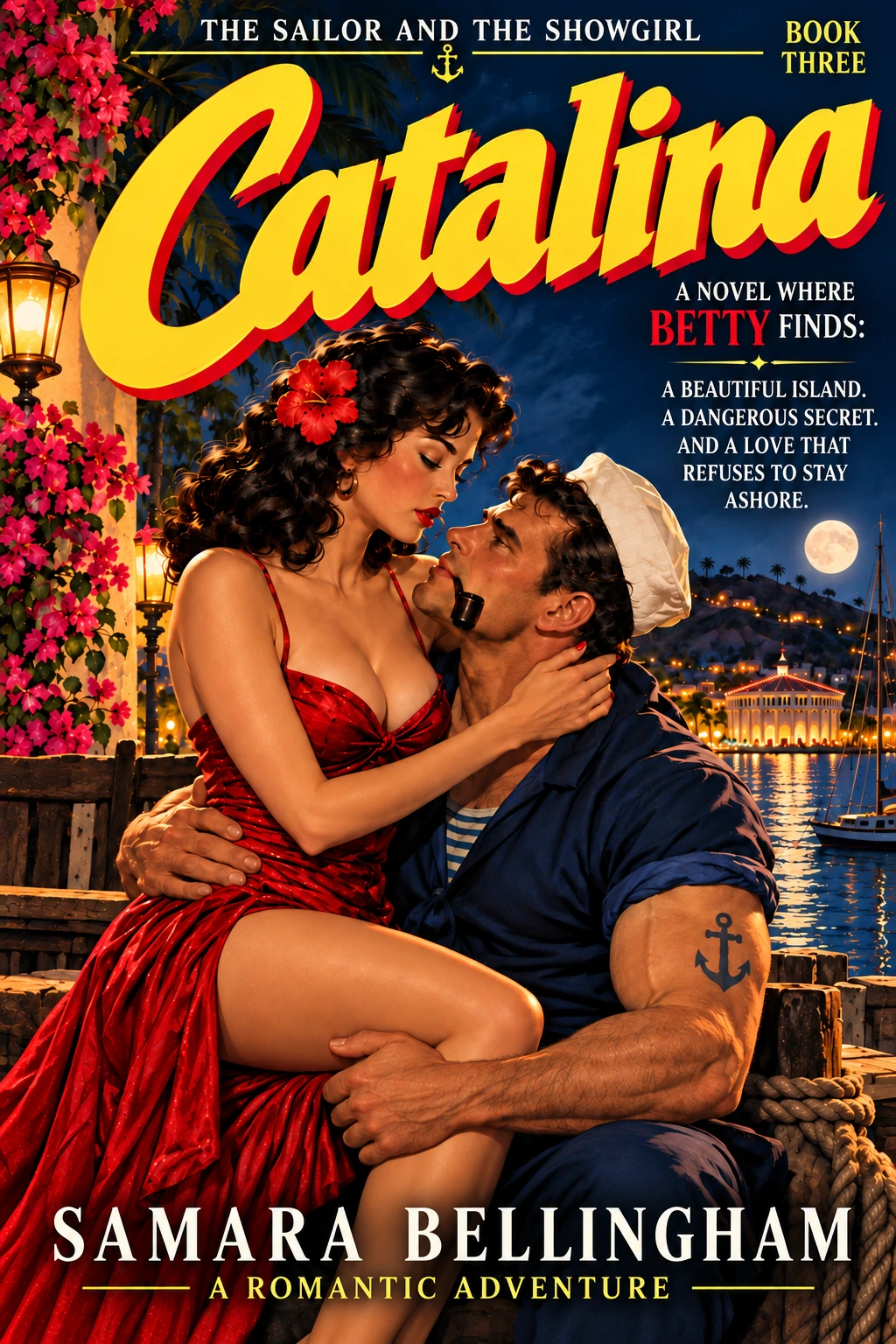
Coming
With Bluto’s nightclub closed after a fire, Betty Boop and Popeye sail for Catalina with Mabel and a charming gentleman of leisure. Dancing, romance, and an unexpected clue complicate the holiday.